Yellow Submarine is a 1966 song by The Beatles, written by Paul McCartney (credited to Lennon/McCartney), with lead vocals by Ringo Starr. It was included on the Revolver album and issued as a single, coupled with Eleanor Rigby. McCartney was living in Jane Asher's parents' house when he found the inspiration for the song: "I was laying in bed in the Ashers' garret. I was thinking of it as a song for Ringo, which it eventually turned out to be, so I wrote it as not too rangy in the vocal, then started making a story, sort of an ancient mariner, telling the young kids where he'd lived. It was pretty much my song as I recall...I think John helped out. The lyrics got more and more obscure as it goes on, but the chorus, melody, and verses are mine." In 1980, John Lennon talked about the song: "Yellow Submarine is Paul's baby. Donovan helped with the lyrics. I helped with the lyrics too. We virtually made the track come alive in the studio, but based on Paul's inspiration. Paul's idea. Paul's title... written for Ringo." Donovan added the words, "Sky of blue and sea of green". McCartney also said: "It's a happy place, that's all. You know, it was just... We were trying to write a children's song. That was the basic idea. And there's nothing more to be read into it than there is in the lyrics of any children's song." In the United States, the single reached #2 on the Billboard Hot 100 in October 1966, where it was held off #1 by The Supremes' You Can't Hurry Love. It sold 1,200,000 copies in four weeks and earned The Beatles their 21st U.S. Gold Record, beating the record set by Elvis Presley.
Though Eleanor Rigby was not the first pop song to deal with death and loneliness, it came as quite a shock to pop listeners in 1966. It took a bleak message of depression and desolation, written by a famous pop band, with a sombre, almost funeral-like backing, to the #11 spot on the Billboard Hot 100 in October 1966. The bleak lyrics were not The Beatles' first deviation from love songs but were some of the most explicit. With a double string quartet arrangement by George Martin and striking lyrics about loneliness, Eleanor Rigby continued the transformation of The Beatles from a mainly pop-oriented act to a more experimental studio-based band. McCartney said he came up with the name Eleanor from actress Eleanor Bron, who had starred with The Beatles in the film Help!. Rigby came from the name of a store in Bristol, Rigby & Evens Ltd, Wine & Spirit Shippers, that he noticed while seeing his then-girlfriend Jane Asher act in The Happiest Days Of Your Life. He recalled in 1984, "I just liked the name. I was looking for a name that sounded natural. Eleanor Rigby sounded natural." However, it has been pointed out that the graveyard of St. Peters Church in Liverpool, where John Lennon and Paul McCartney first met, contains the gravestone of an individual called Eleanor Rigby. Paul McCartney has admitted he may have been unconsciously influenced by the name on the gravestone.

 Rush to Judgment was the first book to challenge the Warren Commission findings of the Kennedy assassination. Mark Lane is an attorney who took it upon himself, in the weeks following the assassination of President John F. Kennedy and the murder of his alleged killer Lee Harvey Oswald, to represent Oswald's mother and widow and to try to find any information he could to exonerate Oswald of the president's murder. What he found out is the basis of what many consider the "original conspiracy theory" -- that Oswald, even if he did pull the trigger, did not act alone in killing JFK. In his book Rush to Judgment, published in 1966, Lane doesn't set forth a theory of who he thinks did kill JFK. He doesn't even say that he is 100 percent sure Oswald didn't do it. What he does propose is that the Warren Commission appointed by President Johnson to investigate the assassination was too quick to finger Oswald as the lone assassin and that its investigations were badly handled, including ignoring evidence and witnesses that could have cast doubt on Oswald's guilt.


 On January 1, 1966, viewers of the Rose Bowl were first introduced to the new "Leader of the Dodge Rebellion", the 1966 Charger. The Charger's debut also followed by a half model year the introduction of a new street version of the 426 cu in Chrysler Hemi engine. With the Charger, Dodge had a new model to build a performance image to go along with this engine. Designed by Carl "CAM" Cameron, the Dodge Charger introduced a fastback roof line and a pot-metal "electric shaver" grille. The grille used fully rotating headlights (180 degree) that when opened or closed made the grille look like one-piece unit. Hidden headlamps were a feature not seen on a Chrysler product since the 1942 DeSoto. In the rear of the new Dodge, the fastback design ended over a full-width six-lamp taillight that featured chromed "CHARGER" lettering. Inside, the standard Charger featured a simulated wood-grain steering wheel, four individual bucket seats with a full length console from front to rear. The rear seats and rear center armrest pad also folded forward while the trunk divider dropped back, which allowed for generous cargo room. Numerous interior features were exclusive to the Charger including door panels, courtesy lights, as well as premium trim and vinyl upholstery. The instrument panel did not use regular bulbs to light the gauges, but rather electroluminescence lit the four chrome-ringed circular dash pods, needles, radio, shifter-position indicator in the console, as well as clock and Air Conditioning controls if equipped. The dash housed a 0 to 6000 rpm tachometer, a 0 to 150 mph speedometer, as well as alternator, fuel, and temperature gauges as standard equipment. Engine selections consisted of only V8s, though a straight-six engine engine became standard by 1968. 1966 transmissions included a three-speed steering-wheel mounted manual with only the base engine, a console mounted four-speed manual or three-speed automatic. In 1966, four engines were offered: the base-model 318 cu in 2-barrel, the 361 cu in 2-barrel, the 383 cu in 4-barrel, and the new 426 Street Hemi. Only 468 Chargers were built with the 426. Total production in 1966 came to 37,344 units for the mid-model year introduction. In 1966 Dodge took the Charger into NASCAR in hopes that the fastback would make their car a winner on the high-banks. But the car proved to have rear end lift around corners which made it very slippery on the faster tracks. The lift was because the air actually traveled faster over the top of the car than under it, causing the car to act like a giant airplane wing. Drivers would later claim that "it was like driving on ice." In order to solve this problem Dodge installed a small lip spoiler on the trunk lid which improved traction at speeds above 150 mph. They also had to make it a dealer-installed option in late 1966 and 1967 because of NASCAR rules. The 1966 Charger was the first U.S. production vehicle to offer a spoiler. David Pearson, driving a #6 Cotten Owens-prepared Charger, went on to win the NASCAR Grand National championship in 1966 with 14 first-place finishes.


 The 39th annual Miss America Pageant was held at the Boardwalk Hall in Atlantic City, New Jersey on September 11, 1965, and was broadcast live on the CBS Network. It was the first color telecast of The Miss America Pageant. Miss Kansas, Deborah Bryant, was chosen as the new Miss America for 1966. The first runner-up was Miss Mississippi, Patricia Puckett. Deborah Irene Bryant, from Overland Park, Kansas, was 19 years old when she won the preliminary swimsuit competition and was announced as the winner of the crown the next day. After graduating in the top ten of her high school graduating class, Bryant went on to attend Columbia College on a full academic scholarship, during which time she represented Kansas in Atlantic City on September 11, 1965, in the Miss America Scholarship Pageant. Following her year of service as Miss America, Bryant continued her education as an English major at the University of Kansas, graduating Cum Laude Phi Beta Kappa. During her year of service, she spoke in support of "Project Concern" which provided medical support to undeveloped countries. Bryant remains active in community service for numerous charitable projects. She was a member of the Mesa Desert Club, which provides scholarships to qualified needy high school graduates, and was also a past member of the Phoenix Junior League. Bryant currently resides in Arizona with husband, Brent. Together they have five children and four grandchildren.


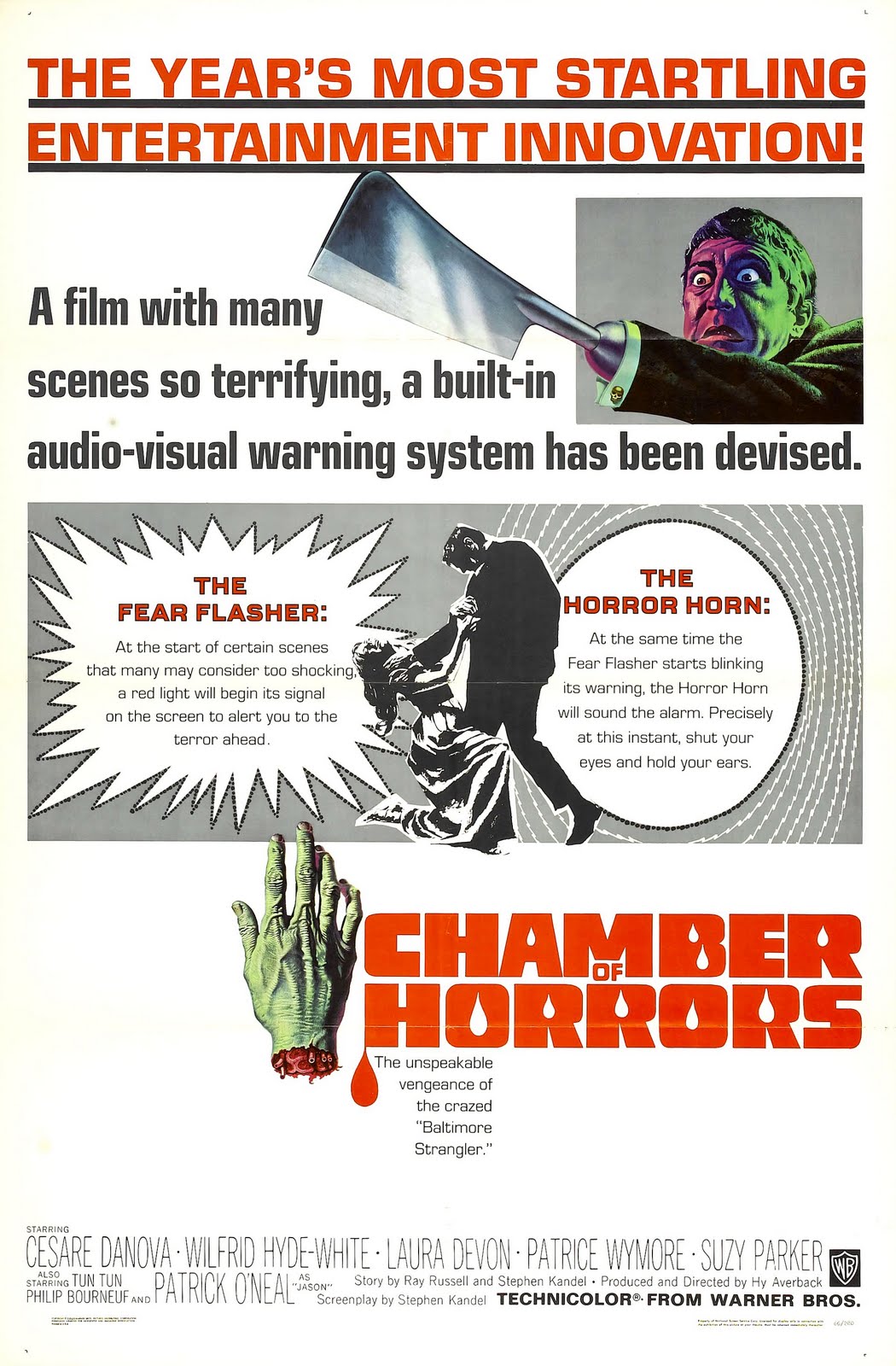
 IN THEATERS NATIONWIDE STARTING OCTOBER 28!
Starring Patrick O'Neal, Cesare Danova, Wayne Rogers, Jeanette Nolan, Laura Devon, Wilfrid Hyde-White, Suzy Parker, Marie Windsor, Vinton Hayworth, Jean Carson, and featuring an unbilled appearance by Tony Curtis. Directed by Hy Averbeck. A claw-handed escaped maniac rampages through late 19th-century Baltimore on a mission of vengeance, using various detachable devices as murder weapons to gain revenge on those he believes have wronged him. Hot on his trail are the proprietors of a "House of Horrors" wax museum and their Mexican dwarf sidekick. The movie features a couple of gimmicks - the "Fear Flasher" and "Horror Horn" - to prepare audiences for upcoming bouts of onscreen bloodletting.


 IN THEATERS NATIONWIDE STARTING FEBRUARY 23!
Starring Paul Newman, Lauren Bacall, Robert Wagner, Robert Webber, Shelley Winters, Strother Martin, Janet Leigh, Arthur Hill, Julie Harris, Pamela Tiffin, and Harold Gould. Directed by Jack Smight. Lew Harper is a hip down-on-his-luck L.A. private detective whose business has gone south. At the suggestion of his friend, attorney Albert Graves, the Harper takes on the investigation of the disappearance of the wealthy husband of an irritating cripple, getting involved along the way with an assortment of unsavory characters and an illegal-alien smuggling ring.


 IN THEATERS NATIONWIDE STARTING JUNE 15!
Starring Ann Margret, Robert Cummings, Mike Connors, Red Buttons, Bing Crosby, Van Heflin, Slim Pickens, Keenan Wynn, Stefanie Powers, and Alex Cord. Directed by Gordon Douglas. Outbound from a small town recently besieged by Indians, a stagecoach carries several diverse characters, including a rum-soaked doctor, a dance-hall girl and prostitute, an embezzling bank clerk, a pregnant army officer's wife, a lawman, and several others unsavory characters. En route, the drunken doctor is forced to sober up and deliver the baby, and the travelers are joined by an outlaw falsely accused of killing his own father and brother.